

Community Advisory Board Research Highlights Challenges to Food Access and Pathways Forward
October 21, 2026
Our Food Bank Network is Here to Help — Find Food and Resources
In 2024, California Food Banks and The Praxis Project launched a Community Advisory Board (CAB) to ensure that community voices help shape research and solutions around food insecurity. Made up of community-based organizations serving diverse populations across California, the CAB works to identify barriers to food access and elevate the lived experiences of the communities most affected.
Building on that mission, CAB members collaborated on a statewide survey and focus group project examining food access challenges across California.
Research Grounded in Community Experience
CAB members designed the project to better understand how communities are experiencing food insecurity amid rising living costs, economic uncertainty, and concerns about immigration enforcement.
The project began with focus groups conducted in late 2025 with leaders from community-based organizations across California. Insights from those discussions informed the development of a survey reflecting the priorities and concerns raised by community partners. In spring 2026, five CAB organizations across the state administered the survey to people visiting their food programs. A total of 269 adults participated, completing surveys in English, Spanish, and Chinese.
For CAB members, one of the greatest benefits of the project was the opportunity to connect immediate experiences to a broader statewide picture.
“I’m very familiar with San Francisco problems. However, I have no idea what is happening in Los Angeles or San Diego. I learned a lot through joining the CAB and learning about some of the similar issues, some of the different issues that we can advocate together,” said Fanny Lam, Executive Director of APA Family Support Services.
Similarly, Akilah Templeton, President and CEO of Veterans Village of San Diego, said participation in the CAB helped ensure that veterans’ experiences were included in broader conversations about hunger and poverty.
“Veteran food insecurity, in my opinion, must be included in California’s larger conversation about hunger and poverty.”
What We Learned
The findings paint a picture of households facing multiple and overlapping economic challenges.
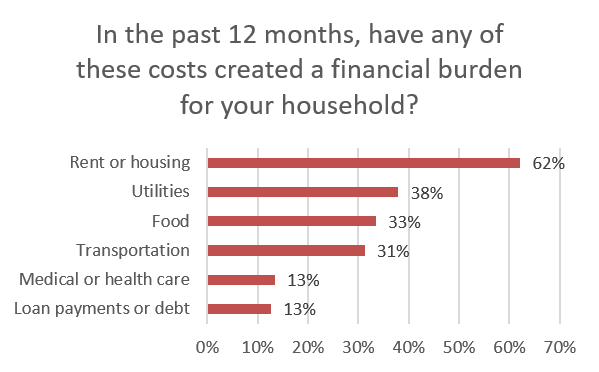
More than six in ten respondents reported household incomes below $30,000 annually, and 70% screened positive for food insecurity. Rent and housing costs were identified as the most significant financial burden, with 62% reporting that housing expenses created hardship in the past year.
Utilities, food, and transportation costs were also common sources of strain.
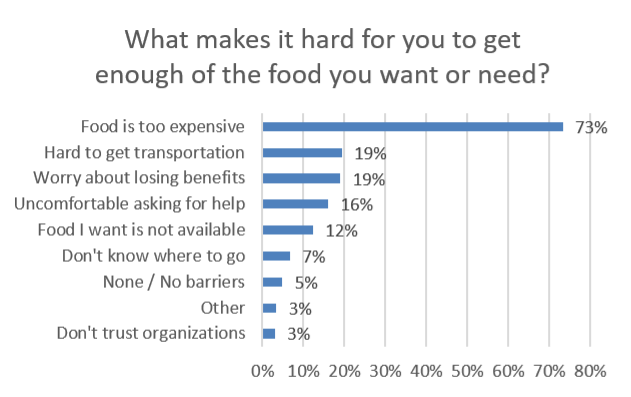
Food prices emerged as the most immediate barrier to accessing enough food. Nearly three-quarters of respondents identified the high cost of food as a primary barrier to getting enough food.
Eighty-four percent of respondents said food costs had increased during the previous 12 months.
As a result:
Templeton noted that food insecurity rarely exists in isolation from other financial pressures.
“We don’t want veterans to have to choose between food, housing, transportation, health care. And that’s what is happening in a lot of these instances.”
Communities Need More Than Food Assistance
The survey findings suggest that many households are looking beyond short-term assistance and seeking resources that can help improve their long-term stability.
One finding that stood out to CAB members was that many respondents viewed food assistance as a temporary support during a difficult period rather than a permanent need.
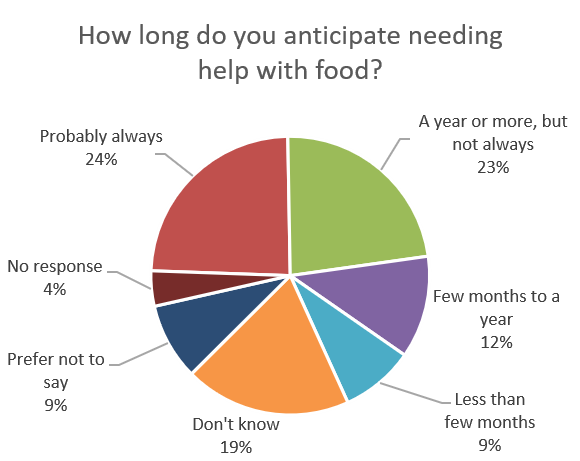
Lam said she was encouraged by the optimism reflected in the responses.
“Only a small percentage of people said, ‘I will need this forever.’ Some people said, ‘I’ll be out in six months,’ or ‘I’ll be out in 12 months.’ That’s a really good sign. I’m really happy to see the result that there is hope.”
The finding highlights the importance of connecting food assistance with programs that help households regain financial stability.
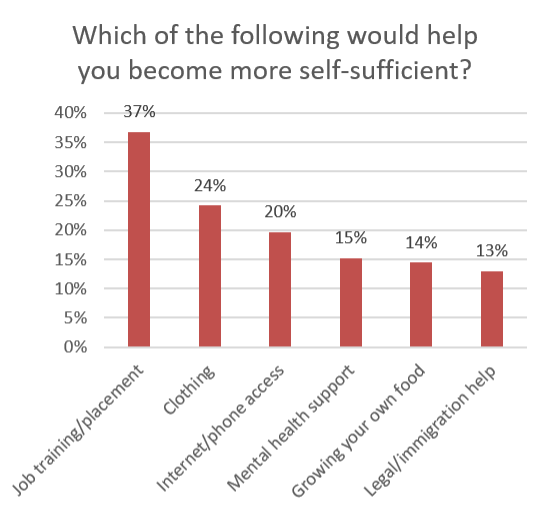
As Lam explained:
“Through food distribution, the next question that we always discuss in our CAB is: What leads to the food need? With job training, creating jobs, helping them find jobs, those things come into the picture.”
Access to Culturally Relevant Food Matters
Respondents reported varying levels of access to foods that meet both their dietary and cultural needs.
Only about one-quarter of respondents reported that, in general, they “always” or “most of the time” had access to foods that fit their dietary needs, such as vegetarian, halal, allergy-friendly, or other dietary preferences. In contrast, 61% said that the food they received through the food program they were visiting “always” or “most of the time” met their cultural needs.
When asked what foods they would like more of, respondents most frequently identified:
These findings reinforce the importance of providing food assistance that reflects the diverse needs and preferences of California communities.
From Research to Action
While the survey was conducted with a convenience sample and is not representative of all Californians receiving food assistance, it provides valuable insight into the experiences of communities navigating food insecurity in today’s economic and social environment.
For Templeton, one of the most important aspects of the project was that it elevated food access as an issue deserving focused attention.
“This gave us an opportunity to put food as the focal point, because food is often somewhere in the background.”
Beyond confirming existing challenges, the research also provided practical information that organizations can use to strengthen programs, partnerships, and advocacy efforts.
Templeton added: “The survey gave us something over and above just the data. It gave us direction, information that we can use to actually do this work.”
Looking Ahead
The survey findings underscore that food insecurity is shaped by more than the cost of food alone. Housing expenses, transportation barriers, employment challenges, and concerns about safety all influence a household’s ability to access nutritious food.
For CAB members, the project demonstrates the value of community-led research in identifying emerging challenges and informing practical solutions. By bringing together organizations with deep relationships in their communities, the CAB is helping ensure that research reflects lived experience and helps guide future action.
As Templeton reflected: “We’re seeing it, we’re hearing about it, but taking a survey actually gives a voice to it. These are real people. If we’re going to build programs, we need to build those programs based on the current need, and surveys help us do that.”
For a copy of the Community Research Project Brief to explore the survey findings, in greater detail, email Research@cafoodbanks.org.
Acknowledgements
We thank all members of the CAB from 2025-2026: APA Family Support Services, Multicultural Institute, Cultiva La Salud, Wukchumni Tribe, SCOPE LA, Old Grove Orange Farm, and Veterans Village of San Diego, for their participation at various stages of conceptualization, design, implementation, and interpretation of this study. We also thank all participants of focus groups and surveys for sharing their experiences. Finally, we thank the Praxis Project for financial and programmatic support.
Stay up to date in fight against hunger.
